2-Point Method to Make it Easy to Submit to An Art Call
When I started entering my work into art shows, creating work for a specific call for art entry was one of my biggest problems.
I knew what I liked and what I was inspired to create but to follow someone else’s theme and expectations was always a challenge for me. In some ways, it is the same kind of challenge artists face when they have to create commissioned work for collectors.
If I had a piece of work that I’d already created which fit into the theme, then perfect. But to create a new piece just to fit in an entirely new theme – I must say was tough.
Blank Black Background
But over the years, I’ve become more comfortable creating work for a call for art entry. Although now I try not to respond to too many calls for art entry, I’ve come up with a method for answering a themed call for art entry.
It’s got a 2-point checklist:
I must say that the over-arching goal for my 2-point criteria is to continue creating a strong body of work while still being able to submit my work into selected calls for entry.
Be Deliberate When Submitting Work into a Themed Call for art Entry
Create work which fits into my current body of work and satisfies the theme
Write an artist statement that answers why my submission fits into the requested theme
Often, it’s hard to wrap your mind around a theme that is too broad or you feel restricted by a theme that is too specific.
I drew organic shapes on this fabric
But I’ve found that when I distill a themed call for art entry into these two simple points it’s easier for me to have a reference point to start from.
I’ve got to create work for a themed call for art entry for the Connecticut members of SAQA. The theme is “Inspired by Science”. And the deadline is fast approaching. Although I’d been thinking about it, I hadn’t actually started work on it, till this weekend.
I then cut out fabric shapes and attached to the background
There are two opportunities to enter work and I want to do both. One is a small 12 “x 12” and the other is a larger piece that could be up to 60 square inches in size.
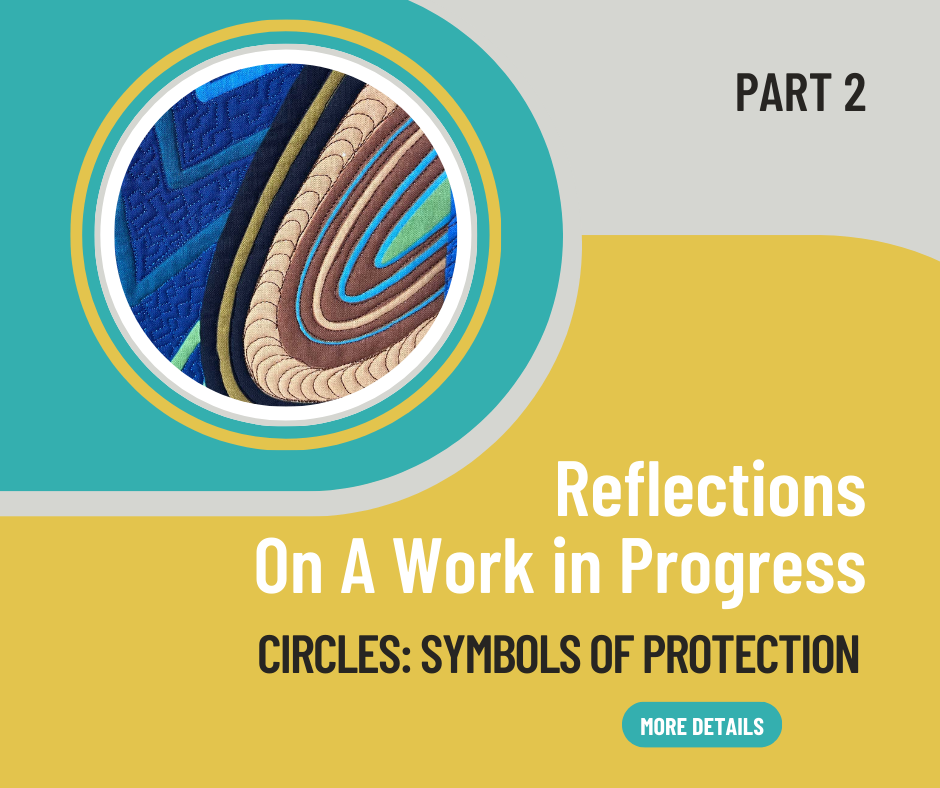
As the managing curator for the show, I can’t not enter work. So, this weekend, I started work on my 12” x 12” piece. I wanted to create something with circular shapes, which is in line with my recent work.
Layering with more fabric cutouts
So, my idea is to create work-related to biological science. The type of things that are in the body and can only be seen under the microscope. I’m thinking of cells, dendrites, and other cool stuff.
The photos show the progression of my work so far. The next step will be to do some creative drawing to add details.
Advantages and Disadvantages of Themed Call for Art Entry
Showing your work is very beneficial. The advantage of submitting work to a themed call for art entry or any show for that matter is that you get to create new work which you otherwise may not create. Thus, if you’re the type who needs prompting to get creative, then the deadlines for shows will be great for you.
Even more layering
There’s a disadvantage to creating and submitting your work to too many calls for art entry, though. If you’re not deliberate about working in your own style, you can end up with a body of work that is not cohesive. That is, your work could look like it was done by different people.
So be selective about submitting your work into a call for entry and deliberate as well.


 I knew what I liked and what I was inspired to create but to follow someone else’s theme and expectations was always a challenge for me. In some ways, it is the same kind of challenge artists face when they have to create commissioned work for collectors.
If I had a piece of work that I’d already created which fit into the theme, then perfect. But to create a new piece just to fit in an entirely new theme – I must say was tough.
I knew what I liked and what I was inspired to create but to follow someone else’s theme and expectations was always a challenge for me. In some ways, it is the same kind of challenge artists face when they have to create commissioned work for collectors.
If I had a piece of work that I’d already created which fit into the theme, then perfect. But to create a new piece just to fit in an entirely new theme – I must say was tough.


 You may also be interested in seeing how this piece turned out.
Other related posts:
How to Select Art Shows to Enter
Understanding the Jurying Process
How to Accept Rejection
You may also be interested in seeing how this piece turned out.
Other related posts:
How to Select Art Shows to Enter
Understanding the Jurying Process
How to Accept Rejection