Hey creative friends, this year, I decided to do a contemporary textile art trends report to provide lovers of textile art, collectors, and textile artists a peek into what to expect in 2019 and now, I’m excited to a share it with you.
First, why did I take the time to do a textile art trends report and why should you be interested in it? Well, I did it for a couple of reasons. Let’s take a look at each of them individually.
Why Textile Art Trends Matter
Textile Art Trends Report
Creativity is not something that’s done in isolation. No matter how you may try to convince yourself that creativity is a solitary activity, it’s not. Here are the reasons you want to know the textile art trends – what others are creating:
Stay Informed: Learning about the current textile art trends helps you stay informed about what is going on in the field of textile art.
Up-to-Date: Textile art is a global phenomenon. There is so much going on all over the world and available online (both old practices and newer ones). For this reason, it can be hard to sort out what is relevant. A trends report helps you do just that.
Inspiration is everywhere. One of the greatest ways to get inspiration for your own work is by seeing what materials others are using and what they’re creating. A textile art trends report serves as a treasure trove of inspiration.
Guidance: If you’re looking for help, guidance or answers to some questions, about textile art, this trends report can provide you with the guidance you need or validate certain things you’re already doing.
Connections: Finally, it introduces you to artists and makers you may not have heard about and with whom you can connect.
The format I’m using for the 2019 Contemporary Textile Art Trends report is multi-media (text, images and a video interview). Since the idea occurred to me, I’ve been thinking and planning how to execute it. And I’m glad that finally it’s all done and available for you to enjoy.
For this, I spoke with no other than Martha Sielman, the executive director of SAQA (Studio Arts Quilts Associates). SAQA is an international non-profit organization of over 3,400 members. SAQA is dedicated to promoting the art quilt and the artists who create them. And I’m proud to say I’m a member of this great organization.
2019 Contemporary Textile Art Trends Interview Guest
2019 Textile Art Trends ReportMartha Sielman has been Executive Director of Studio Art Quilt Associates, Inc. (SAQA) since 2004. Her career in art quilts began in 1988, when she learned to quilt and has included more than 20 years of work as a professional artist, author, lecturer, curator, juror, and arts administrator. She is the author of several books.
Martha and I had a really nice chat. In it, I even revealed what part SAQA has played in my own professional development. You’ll love hearing all about the textile art trends to expect for this new year in this video interview. Some of these trends have been going on for a while but are expected to continue in coming years.
Below you’ll find the major takeaways from the interview, the artworks of some of the people who were mentioned in the interview and other information related to the interview. This is just a little flavor of some of what we talked about. I encourage you to watch the video to get the full scoop.
TAKEAWAYS from Textile Art Trends Interview
So here are some takeaways from the interview.
The 2019 Textile Art Trends
Political Quilts– The current political climate does not end in Washington, or the halls of government. It is strongly being expressed in textile art and the work that art quilters are creating. This use of art to express political views is not new. In fact, in May of 2018, The New York Times wrote an article entitled “Some of the Most Provocative Art is Made with Fibers“. The article chronicles some of the political work that has been created in fiber art.
Three-Dimensional Art– Three-dimensional work is a trend to watch out for in the textile and fiber art space. Artist, Betty Busby as well as many others are creating some awesome pieces of sculptural work with textiles. So, that’s definitely a trend to watch for. Betty Busby is a graduate of the Rhode Island School of Design, where she majored in ceramics. Below are examples of her 3D fiber work.
Betty Busby, Jerry Can, 36x27x7Betty Busby, In The Weeds, 41x15x21
Hand Stitching – Mark of the Maker. The third on the list is hand stitching. Makers have always wanted their hand to show in their work – the artist’s hand as it’s called. For textile artists, the need to have their hand show in their work as well as a need to slow down, be in the moment and appreciate what is around us, is reflected in a resurgence in hand stitching in textile pieces again. An example of an artist who incorporates hand stitching in her work is Deborah Boschert. A sample of her work is shown below. Look out for the hand stitches close to the hem of the girl’s dress. To see more of Deborah’s work and learn about her, see my interview with Deborah.
Deborah Boschert, Waxing Crescent
More Textile Art Trends
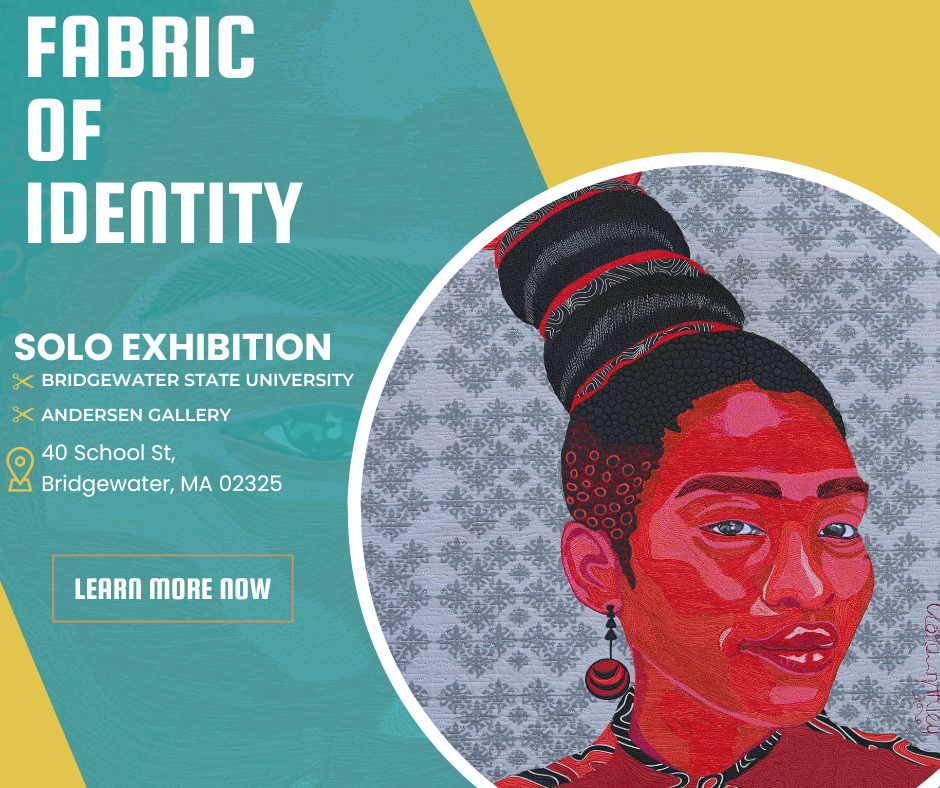
Matchstick (Machine Sewing)– Due to advanced technology, influx of mid to long arm quilting machines, more and more textile artists are using stitching as a feature in their work. Matchstick quilting (didn’t know the name until Martha mentioned it, duh) has become prevalent. Matchstick quilting refers to tight lines of quilting/stitching. An example of this kind of work is that by yours truly. Yes, I stitch very closely together and I do this as a form of shading my drawings rather than a background effect. Most people on a domestic sewing machine use a walking foot for stitching the tight straight lines. I don’t. I do it free motion with a darning foot. Below is an example. Read and watch how this piece was created here.
Clara Nartey, Stacked Houses #2Textile Art Trends (Matchstick Stitching) Stacked Houses #2, detailTextile Art Trends (Matchstick Stitching) Detail, Stacked Houses #2
Even More Textile Art Trends
Reuse of Materials– Tea bag quilts, Makeup cleaner. In recent years, there’s a general consumer need towards sustainability in all aspects of life including social and environmental sustainability. This trend is reflected in the reuse of materials in textile art. This is manifested in different forms, be it reuse of clothing or tea bags or makeup cleaners in the art being created by today’s textile artist. Artist Libby Williamson, uses teabags for her art quilts. Below you’ll find examples of Libby’s creative teabag quilts.
2019 Textile Art Trends| Libby Williamson’s Teabag Quilts2019 Textile Art Trends| Libby Williamson’s Teabag Quilts
There’s a whole lot more discussion of this and other interesting topics in the video. So watch the video interview and get the entire scope. You’ll be missing so much if you don’t.
Enjoy!
Warmest Regards,
Question: Are you or someone you know creating work in any of these trends? Comment and share your thoughts below. It’ll also be great if you make suggestions for future reports. I can’t wait to hear what you all think about this textile art trends report.




 Question: Are you or someone you know creating work in any of these trends? Comment and share your thoughts below. It’ll also be great if you make suggestions for future reports. I can’t wait to hear what you all think about this textile art trends report.